CallTrackingMetrics Review
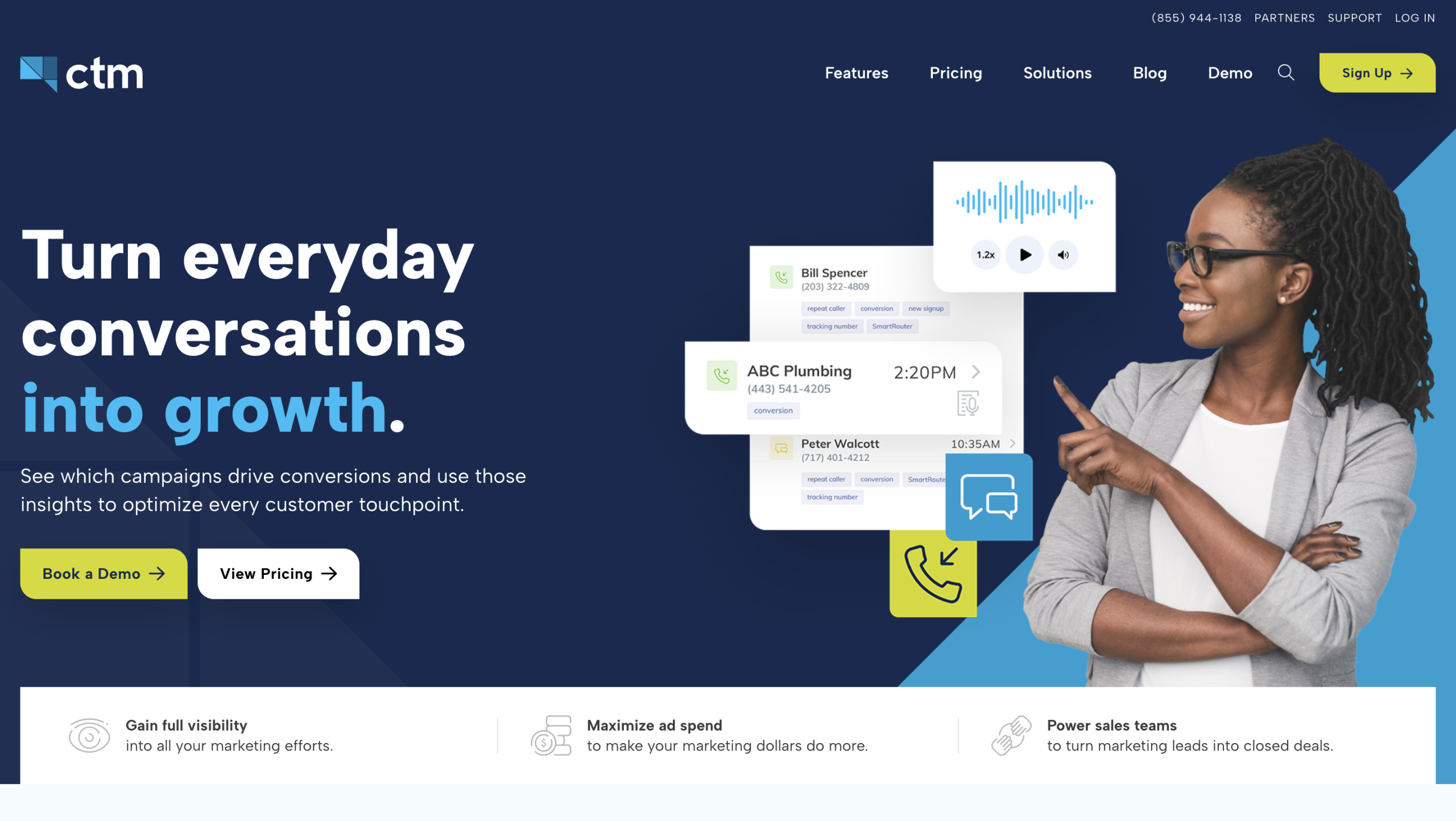
CallTrackingMetrics, now also branded as CTM, has grown from a call tracking tool into a broader conversation analytics platform for businesses that rely on phone calls, texts, forms, and chats to generate revenue. Its current positioning is less about simple attribution and more about helping teams understand every customer interaction and act on that data with routing, automation, and AI-powered insights.
For businesses that treat inbound calls as a serious revenue channel, CallTrackingMetrics can do much more than assign tracking numbers. It can connect calls to campaigns, score conversations, route leads, track texts and forms, and push useful data into platforms like Google Ads and CRMs. That makes it a stronger fit for teams that want both attribution and operational control in one place.
Quick Verdict
CallTrackingMetrics is one of the more capable platforms in this category, especially for agencies, multi-location businesses, healthcare organizations, and sales teams that need configurable call flows and strong reporting. Its main strengths are flexibility, multi-channel tracking, AI-assisted conversation intelligence, and a wide range of integrations. Its main downside is that the platform can feel heavier than simpler tools if you only need basic call tracking.
Our rating: 4.4/5
| Category | Score |
| Ease of Use | 4.2/5 |
| Features | 4.7/5 |
| Reporting & Attribution | 4.6/5 |
| AI & Automation | 4.5/5 |
| Pricing Clarity | 4.0/5 |
| Overall Value | 4.4/5 |
This score is an editorial assessment based on public product information, pricing pages, feature depth, and the overall sentiment visible across review platforms. It is not a benchmark lab test. Third-party review sources consistently highlight customization, support, reporting, and integrations as strengths, while setup complexity appears more often in tradeoff discussions.
What CallTrackingMetrics Is Best For
CallTrackingMetrics is best for businesses that need more than just dynamic number insertion and basic source tracking. If your team wants to follow a lead across calls, texts, forms, and chats, then analyze those interactions with AI and route them intelligently, CTM is built for that kind of workflow.
It is especially well suited to organizations where missed calls, poor routing, or weak visibility into sales conversations can directly hurt revenue. That includes agencies managing client attribution, healthcare and admissions teams, home services businesses, and companies with higher call volume or more complex intake flows. CTM also publicly highlights vertical use cases including healthcare-focused workflows and contact-center-oriented capabilities.
Standout Features
One of the biggest reasons buyers choose CallTrackingMetrics is flexibility. The platform supports call tracking, call routing, text messaging, form tracking, chat, reporting, and conversation intelligence inside one system rather than forcing you to stitch together several separate tools. For some teams, that means fewer handoffs and a clearer view of what actually drives leads and revenue.
Its AI layer is also more than a checkbox feature. CTM’s conversation intelligence includes recordings, transcriptions, customizable AI prompts, automated tagging, scoring, and workflows that can escalate calls, identify opportunities, and send scored conversations into Google Ads. That makes the product more useful for teams that want to automate follow-up and improve lead handling, not just report on calls after the fact.
“We started as call tracking software, but today we’re a communications intelligence platform.”
— Todd Fisher, Co-Founder & CEO, CTM
That quote matters because it reflects how buyers should evaluate the product today. If you compare CallTrackingMetrics as if it were only a call tracking tool, you may underestimate what it can do. If you evaluate it as a platform for attribution, routing, AI insights, and communication workflows, its value proposition becomes much clearer.
Pricing
CallTrackingMetrics publicly lists plans starting at $79/month billed monthly on its global pricing page, while annual prepay options can lower the effective monthly cost. The company also presents multiple tiers and usage-based telephony costs, so the real monthly bill depends on your volume, numbers, minutes, and feature needs.
For smaller businesses, that pricing can still be reasonable if calls are a major part of the funnel. But for low-volume teams that only need lightweight attribution, CTM may feel more advanced than necessary. That tradeoff also appears in third-party review commentary, where users often praise the feature depth but note that smaller or simpler use cases may not fully benefit from the platform’s complexity.
| Plan Snapshot | What to Know |
| Entry pricing | Starts at $79/month monthly |
| Billing model | Subscription + usage-based costs |
| Best value | Teams with steady call volume |
| Watch for | Extra telephony and scaling costs |
Ease of Use
CallTrackingMetrics is powerful, but it is not the lightest tool in the category. Users who want simple setup and minimal configuration may find it more involved than products built primarily for SMB marketers. On the other hand, teams that need advanced call flows, custom routing, multi-channel tracking, and deeper reporting often see that complexity as the reason to choose it.
That pattern shows up repeatedly in review sentiment: CTM is often praised for customization and support, but the same flexibility can create a steeper learning curve for teams without a clear implementation plan. In other words, it is not hard because it is bad; it is hard because it can do a lot.
Integrations and Reporting
CallTrackingMetrics integrates with many of the tools marketers and sales teams already use, including platforms for advertising, CRM, analytics, and communications. Public materials highlight integrations with Google Ads, Google Analytics, HubSpot, Salesforce, Zoom, and Facebook-related workflows, which makes CTM easier to fit into an existing stack.
This matters because call tracking software becomes much more valuable when it does not sit in isolation. The ability to connect conversation data to ad platforms and CRM systems can improve reporting, optimize campaigns, and help teams tie offline conversations back to actual pipeline outcomes.
Pros and Cons
Pros
- Broad feature set across calls, texts, forms, and chats
- Strong routing and workflow flexibility
- AI summaries, tagging, scoring, and automation
- Good fit for agencies and higher-volume teams
- Strong reporting and attribution potential
Cons
- Can feel complex for simple use cases
- Pricing can rise with usage
- Better suited to teams that will use its deeper features
- Not the easiest option for buyers who only need basic tracking
The short version is that CTM is a high-ceiling platform. That is a major advantage for the right buyer and unnecessary overhead for the wrong one.
Final Verdict
CallTrackingMetrics is one of the better options in this market for businesses that need more than basic call attribution. It combines call tracking with routing, AI, reporting, and multi-channel visibility in a way that can support both marketers and operational teams. If your business depends heavily on inbound conversations and you want one system that can help analyze and act on them, CTM is worth serious consideration.
If you only need lightweight call tracking with simpler setup, there are easier tools to start with. But if you want deeper configurability, richer communication data, and stronger automation potential, CallTrackingMetrics is a platform that can grow with you.