CallRail vs Invoca
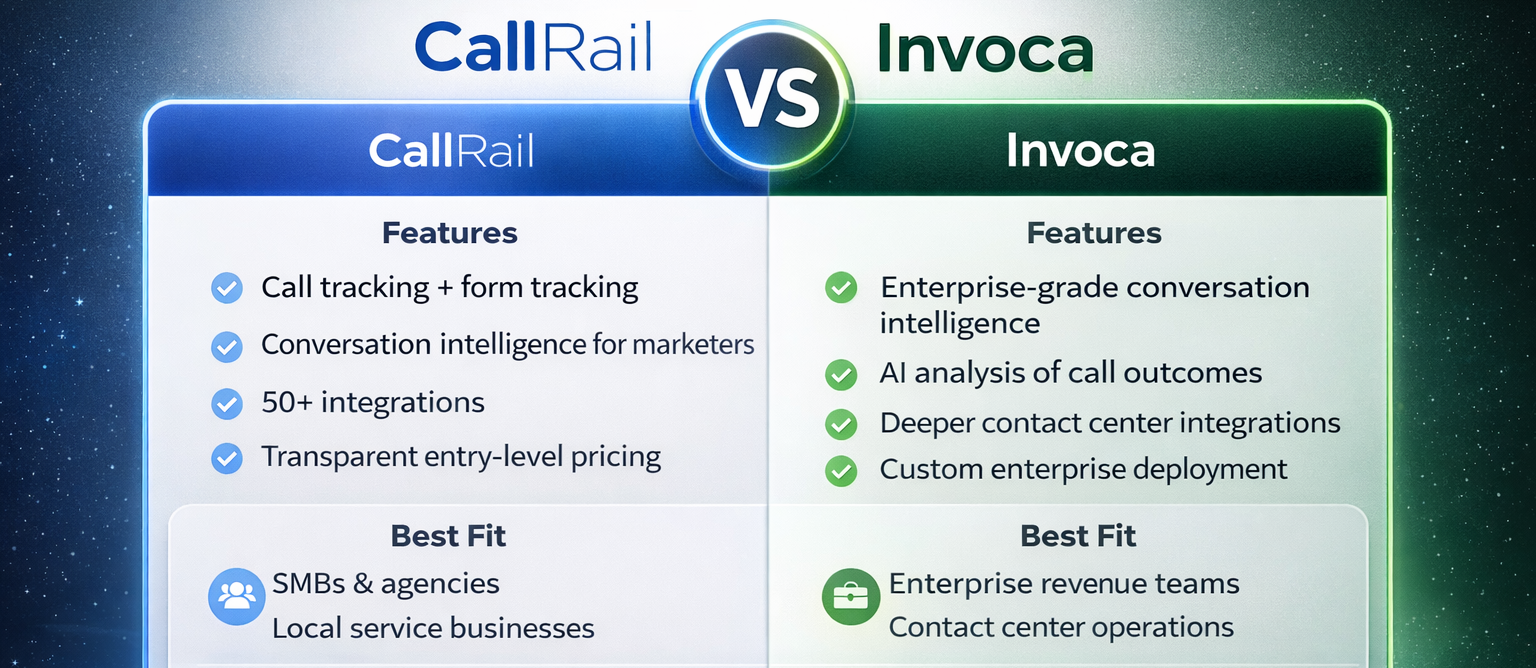
When comparing CallRail vs Invoca, the biggest difference is positioning. CallRail is built to make call tracking, form tracking, attribution, and AI-powered conversation insights accessible for small and mid-sized businesses, with public entry pricing starting at $45/month for Lead Tracking and higher tiers for form tracking and premium conversation intelligence. Invoca is positioned as a more enterprise-focused revenue execution and conversation intelligence platform, with pricing available through a custom demo rather than public self-serve plans.
Both platforms support inbound call tracking, conversation intelligence, and integrations with major ad and analytics tools. But they are not identical products. CallRail leans toward simplicity, transparent entry pricing, and usability for businesses that want to connect calls, texts, forms, and chats in one dashboard. Invoca leans more heavily into AI-driven conversation analytics, enterprise workflows, and deeper integration use cases across marketing, contact centers, and revenue teams.
Quick Verdict
Choose CallRail if you want:
- easier entry point
- transparent starting pricing
- call tracking plus form tracking for SMB or mid-market teams
- a simpler platform for marketing attribution and lead management
Choose Invoca if you want:
- enterprise-grade conversation intelligence
- stronger focus on AI analysis of call quality and outcomes
- deeper workflows for contact center and revenue execution teams
- a platform built around advanced integrations and custom deployment
CallRail vs Invoca: Side-by-Side Comparison
| Feature | CallRail | Invoca |
|---|---|---|
| Core positioning | Call tracking and lead conversion platform for marketers and businesses | Revenue execution and conversation analytics platform for enterprise teams |
| Call tracking | Yes | Yes |
| Form tracking | Yes | Not a core public positioning point on main product pages |
| Conversation intelligence | Yes, including transcripts, summaries, sentiment, keyword analysis | Yes, with Signal AI and conversation analytics |
| Public pricing | Yes, starts at $50/month for Lead Tracking | No public self-serve pricing; demo/custom pricing |
| Free trial | Yes, 14-day trial | Demo-led sales process |
| Integrations | 50+ integrations mentioned by CallRail | 50+ integrations and over a dozen no-code integrations mentioned by Invoca |
| Best fit | SMBs, agencies, local service businesses, growing teams | Mid-market and enterprise organizations, contact center-heavy teams |
| Google Ads / analytics integrations | Yes | Yes |
This summary reflects how each vendor presents the platform publicly. CallRail’s pricing page lists Lead Tracking at $50/month, Lead Tracking Complete at $95/month, and Lead Conversion at $150/month, while Invoca routes buyers to custom pricing and demos. CallRail also highlights call, text, form, and chat tracking, while Invoca emphasizes AI-powered call tracking, conversation intelligence, and revenue execution workflows.
Feature Comparison
1. Call Tracking
Both CallRail and Invoca offer call tracking, but they target somewhat different buyers.
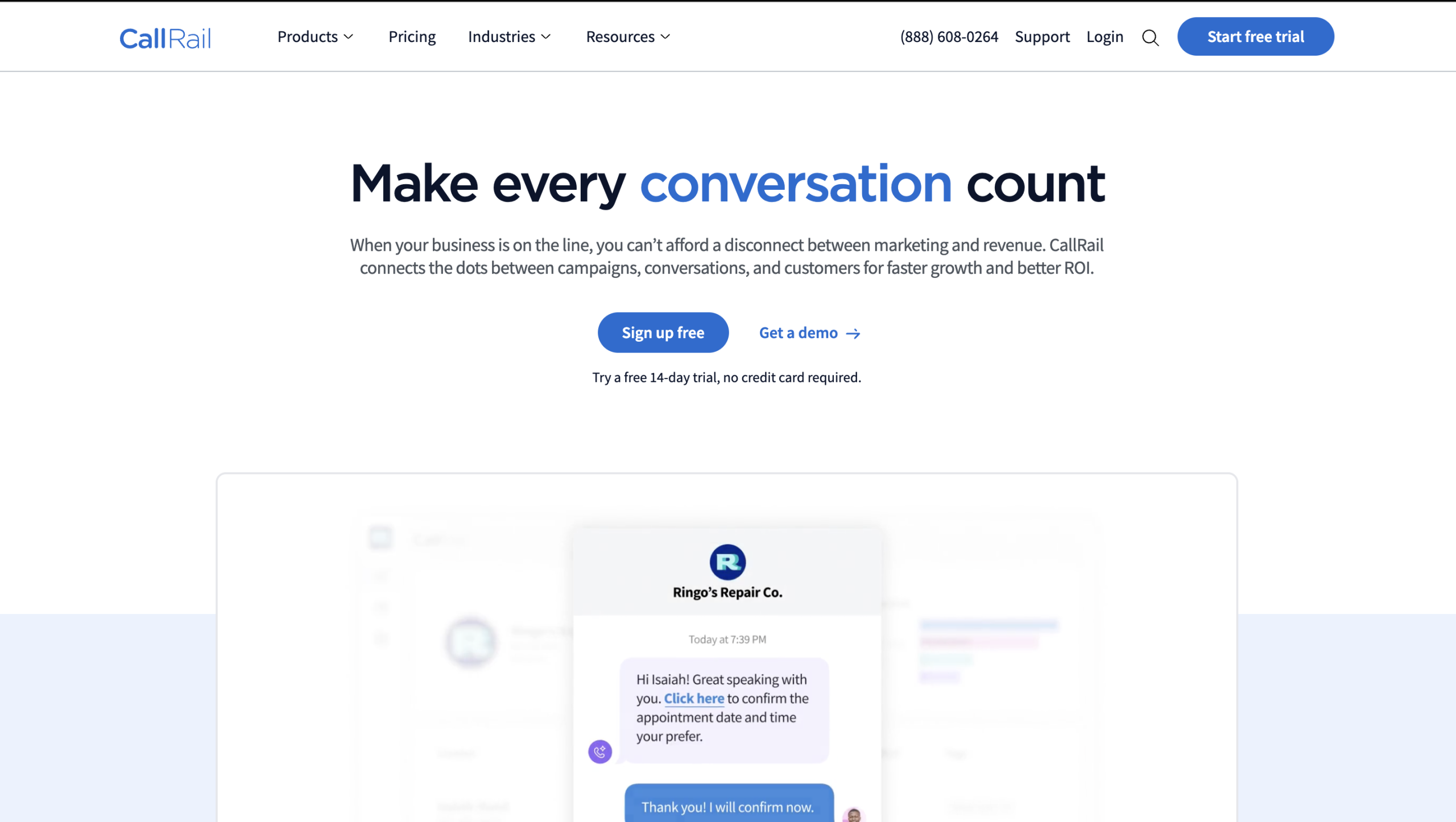
CallRail positions call tracking as an accessible way to track calls, texts, forms, and chats and connect them back to marketing sources in one dashboard. Its base Lead Tracking plan includes tracking numbers, minutes, call and text attribution, recording, routing, transcription, and automation rules.
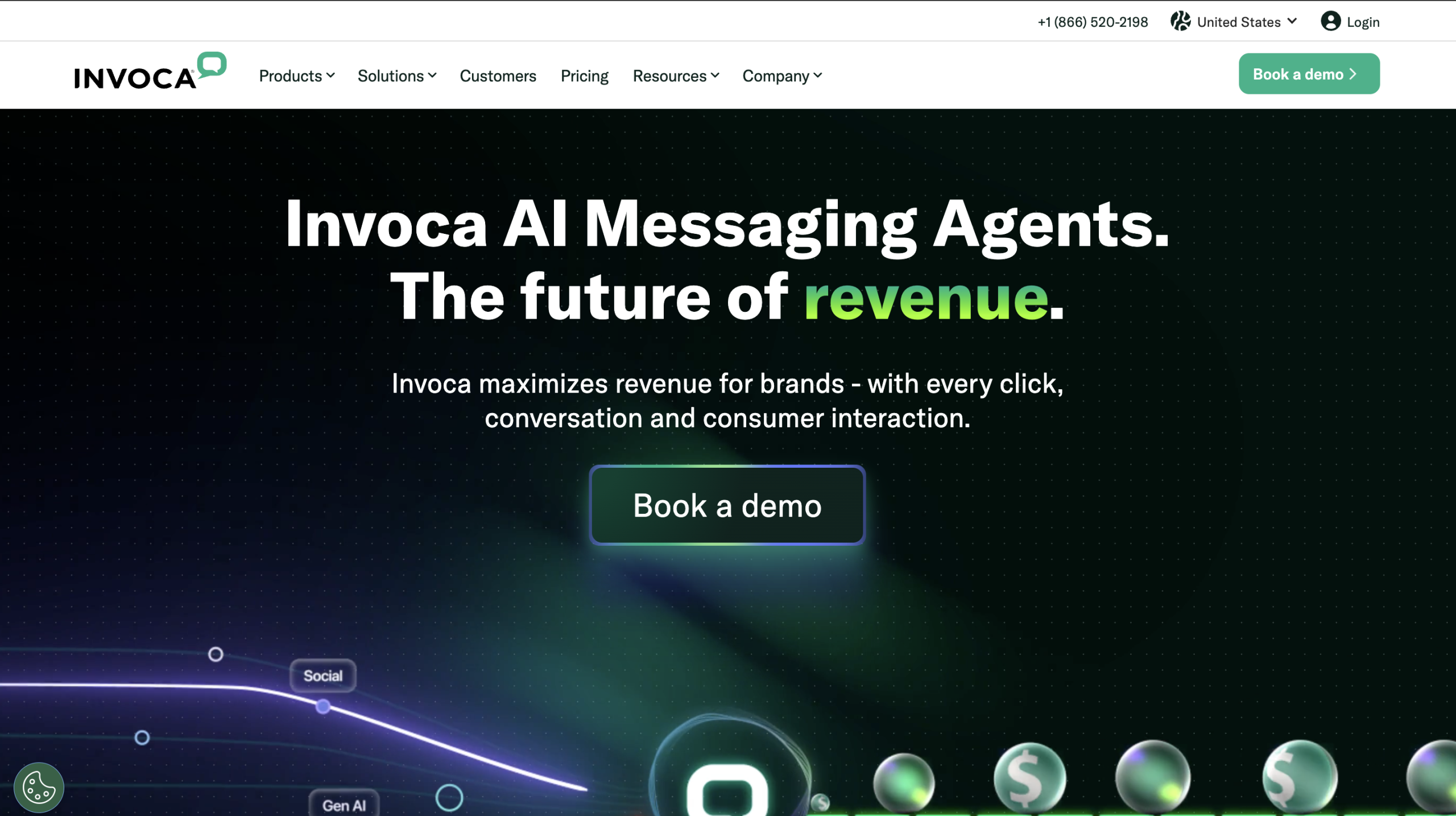
Invoca also offers call tracking, but frames it more as part of a broader AI and revenue execution stack. Its product pages focus heavily on measuring call quality, outcomes, and revenue impact, especially for businesses that rely on phone calls as high-value conversions.
〉Takeaway:
If you need practical call tracking with a lighter learning curve, CallRail is the more straightforward option. If you need call tracking as part of a larger enterprise conversation intelligence workflow, Invoca is likely the stronger fit.
2. Conversation Intelligence
This is one of the most important categories in the comparison.
CallRail includes conversation intelligence features such as call transcripts, summaries, sentiment analysis, keyword analysis, conversation trend reports, and automatic conversion tagging on higher-tier plans.
Invoca’s positioning in this area is more advanced and more central to the product. Its AI stack, including Signal AI, is presented as analyzing calls at scale to identify agent performance, call outcomes, intent, sentiment, and business-specific KPIs. Invoca also emphasizes marketing, sales, and contact center use cases more heavily than CallRail does on its public product pages.
| Conversation Intelligence Capability | CallRail | Invoca |
|---|---|---|
| Call transcripts | Yes | Yes |
| Call summaries | Yes | Yes, via AI-driven analytics |
| Sentiment analysis | Yes | Yes |
| Keyword/topic insights | Yes | Yes |
| Agent performance scoring | Not emphasized as a core public feature | Yes, publicly emphasized |
| KPI-based AI models | Not publicly emphasized in the same way | Yes, publicly emphasized |
〉Takeaway:
CallRail has solid AI features for marketing and lead management teams. Invoca appears stronger for teams that want AI to evaluate calls more deeply and operationalize those insights across larger organizations.
Pricing Comparison
Pricing is one of the clearest differences between these tools.
CallRail pricing
According to CallRail’s public pricing page, the company lists:
- Lead Tracking from $50/month
- Lead Tracking Complete from $95/month
- Lead Conversion from $150/month
- Voice Assist from $95/month, with Call Tracking added separately
Invoca pricing
Invoca does not publish a simple self-serve price table in the same way. Its pricing page and demo pages direct buyers toward a consultation and customized demo, which usually signals a more tailored, sales-led pricing model.
| Pricing Factor | CallRail | Invoca |
|---|---|---|
| Public starting price | Yes | No |
| Self-serve signup | Yes | Primarily demo-led |
| Entry-level accessibility | Higher | Lower |
| Enterprise custom packaging | Limited vs enterprise-focused vendors | Stronger fit |
〉Takeaway:
If transparent starting pricing matters, CallRail wins. If you are already expecting a custom enterprise buying process, Invoca’s pricing model will feel more normal.
Integrations
Integrations matter a lot for teams using Google Ads, GA4, CRM systems, and marketing automation.
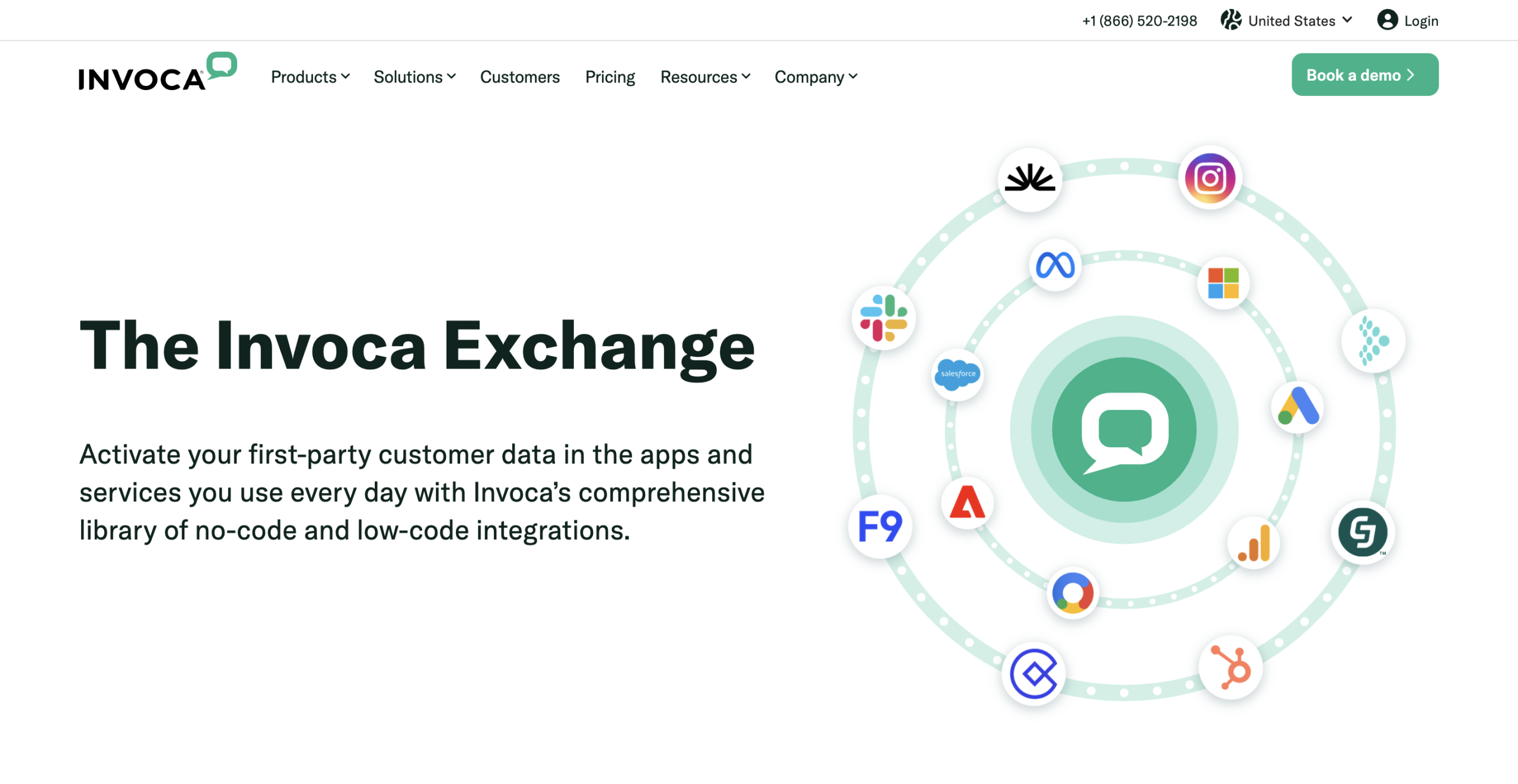
Invoca says it offers dozens of low-code and no-code integrations, and another product page states 50+ integrations plus over a dozen no-code offerings. Public examples include Google Ads, Google Analytics, HubSpot, Facebook, Instagram, Five9, and Impact.
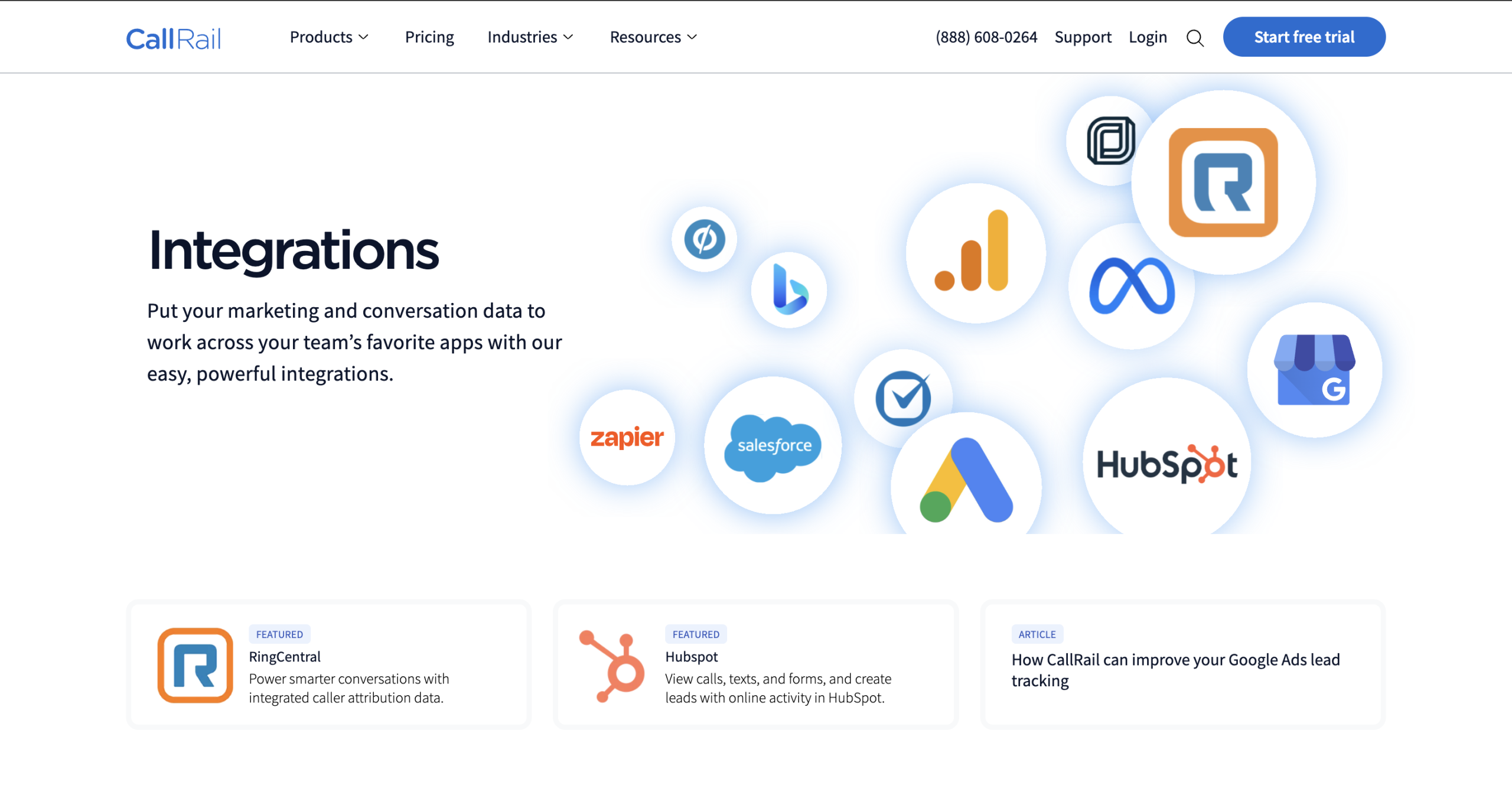
CallRail publicly highlights integrations with Google platforms and states in its content that it has 50+ out-of-the-box integrations. Its ecosystem also includes API access and Google Marketing Platform support.
| Integration Area | CallRail | Invoca |
|---|---|---|
| Google Ads | Yes | Yes |
| Google Analytics / GA4 | Yes | Yes |
| Marketing platform integrations | Yes | Yes |
| CRM / automation integrations | Yes | Yes |
| API access | Yes | Yes |
| Contact center ecosystem depth | Moderate | Stronger |
〉Takeaway:
Both are integration-capable, but Invoca seems more oriented to organizations with larger tech stacks and contact center workflows. CallRail is more than enough for many SMB and agency environments.
Ease of Use and Business Fit
CallRail is easier to recommend for:
- small businesses
- agencies
- local service companies
- teams that want fast setup and public pricing
- businesses that need call tracking plus form tracking in one place
This is supported by CallRail’s public packaging, free trial, and SMB-oriented features like Lead Center and form tracking. CallRail’s support content explicitly says Lead Center was designed with small businesses in mind.
Invoca is easier to recommend for:
- larger marketing organizations
- enterprise sales teams
- contact center operations
- businesses optimizing high-value phone conversions
- organizations that need advanced AI analysis and revenue execution workflows
That conclusion is an inference from Invoca’s product positioning around Signal AI, interaction management, custom demos, and cross-functional marketing/contact-center use cases.
Pros and Cons
CallRail Pros
- transparent pricing
- free trial
- strong mix of call tracking, form tracking, and attribution
- easier starting point for SMBs and agencies
- useful conversation intelligence without obvious enterprise complexity
CallRail Cons
- less enterprise-oriented in public positioning
- may be less suitable for large contact center operations
- advanced AI analysis appears less central than it is with Invoca
Invoca Pros
- strong AI and conversation intelligence positioning
- well suited for enterprise marketing and contact center environments
- robust integrations and revenue attribution focus
- stronger public emphasis on call quality, outcomes, and agent performance
Invoca Cons
- no transparent public entry pricing
- likely heavier implementation and sales process
- may be more platform than a smaller business actually needs
Who Should Choose CallRail?
Choose CallRail if your team wants a practical platform for:
- call tracking
- form tracking
- call attribution
- lead capture and routing
- AI-assisted call summaries and reporting
It is especially attractive if you are an SMB, agency, or local-service brand and want to get started without an enterprise sales cycle.
Who Should Choose Invoca?
Choose Invoca if your organization needs:
- enterprise conversation intelligence
- deeper AI analysis of caller intent and outcomes
- stronger contact center alignment
- custom integrations and a more strategic phone-conversion workflow
Invoca makes more sense when phone calls are a major revenue event and multiple teams need to act on call data at scale.
Final Verdict
CallRail vs Invoca is not really a battle between two identical tools.
CallRail is the better fit for businesses that want a more accessible call tracking platform with transparent pricing, straightforward deployment, and practical lead attribution features. Invoca is the better fit for organizations that need enterprise-grade conversation intelligence, deeper AI analysis, and workflows that connect marketing, sales, and contact centers around phone-driven revenue.
For many SMBs and agencies, CallRail will likely be the easier and more cost-effective choice. For larger organizations with high call volumes and more advanced operational needs, Invoca will likely be the more scalable option. This second sentence is a practical inference based on each vendor’s public positioning, packaging, and sales model.
FAQ
Is CallRail cheaper than Invoca?
CallRail is more transparent on price and publicly lists plans starting at $50/month. Invoca uses a custom pricing process and does not publish comparable self-serve pricing on its main pricing page.
Is Invoca better for enterprises?
Based on public product positioning, yes. Invoca presents itself more strongly around enterprise AI, revenue execution, contact center use cases, and customized deployment.
Does CallRail offer form tracking?
Yes. CallRail publicly offers Form Tracking and includes it in the Lead Tracking Complete plan.
Do both tools integrate with Google Ads?
Yes. Both vendors publicly describe integrations with Google Ads and broader Google marketing/analytics ecosystems.