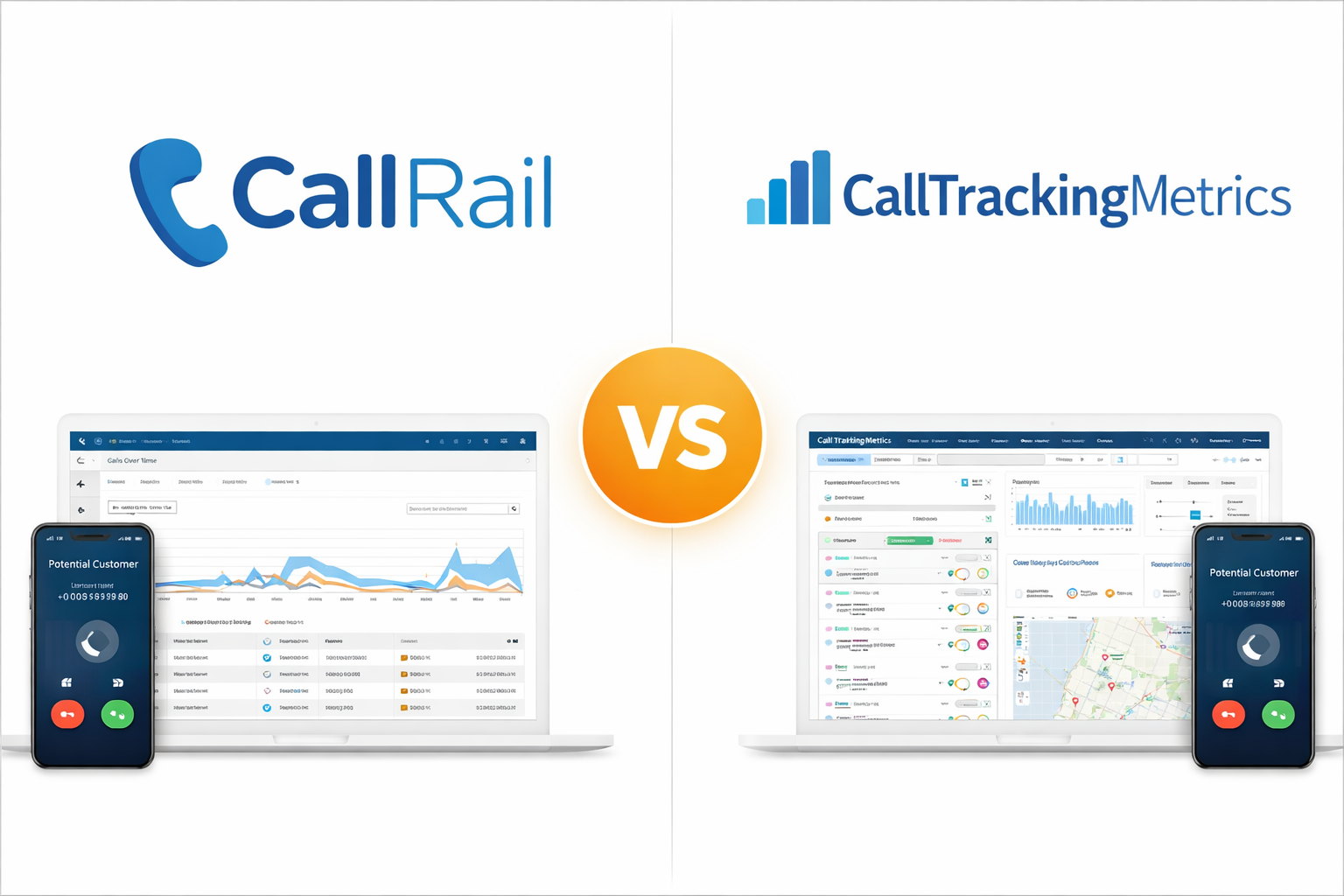
CallRail vs CallTrackingMetrics
When comparing CallRail vs CallTrackingMetrics, the biggest difference is not whether both platforms track calls. They do. The real difference is how broadly each one wants to own the conversation. CallRail is still positioned as a marketer-friendly lead engagement and attribution platform with transparent entry pricing and a self-serve 14-day free trial. CallTrackingMetrics, now branded as CTM, is increasingly positioned as a broader communications intelligence platform that tracks calls, texts, forms, and chats, then layers AI, routing, and workflow automation on top.
For most small businesses, agencies, and local-service teams, CallRail is the easier starting point. For teams that want a more configurable system across calls, texts, forms, chats, AI summaries, routing, and live reporting, CallTrackingMetrics usually has the broader operational ceiling. That second conclusion is an inference from each vendor’s public pricing, feature pages, and product positioning.
Quick Verdict
Choose CallRail if you want:
- simpler onboarding
- clearer starting pricing
- strong call tracking plus form attribution
- a cleaner fit for SMBs and agencies
Choose CallTrackingMetrics if you want:
- a broader communications stack
- deeper routing and workflow flexibility
- stronger emphasis on AI summaries, scoring, and omnichannel activity
- more room for call-heavy sales or service operations
The summary below reflects current public pricing and product pages, not private demos or negotiated enterprise contracts.
| Category | CallRail | CallTrackingMetrics |
| Core positioning | Lead engagement and attribution for marketers | Communications intelligence and conversation analytics |
| Public entry pricing | From $50/month | From $79/month monthly, or $65/month billed yearly |
| Trial / onboarding | 14-day free trial, no credit card | Self-serve sign-up path; official page says no subscription fee for the first month |
| Core channels | Calls, texts, forms | Calls, texts, forms, chats |
| AI / conversation layer | Transcription, analysis, sentiment, auto-tagging, premium CI | AskAI summaries, scoring, AI prompts, sentiment, workflow triggers |
| Integrations | 60+ integrations | 40+ native integrations plus no-code automation options |
| Best fit | SMBs, local-service brands, agencies | Agencies, multi-location teams, call-heavy sales/service ops |
The Biggest Difference in 2026
CallRail still feels like a platform built to answer a marketer’s first question: Which campaigns are driving qualified leads? Its public messaging centers on connecting campaigns, conversations, and customers, with call tracking, form tracking, conversation intelligence, and lead capture.
CallTrackingMetrics feels broader. Its own 2026 messaging emphasizes that it has moved beyond “just call tracking” and now wants to help teams understand and act on every customer conversation across channels. That matters because buyers comparing these tools are often deciding between a more focused attribution product and a more configurable communications platform.
“Clicks don’t tell the whole story. Conversations do.”
— Laura Beussman, CallRail CMO/CRO
“We started as call tracking software, but today we’re a communications intelligence platform.”
— Todd Fisher, CTM Co-Founder & CEO
Feature Comparison
1. Call Tracking and Attribution
Both platforms support core call tracking, call routing, and dynamic number insertion. CallRail’s documentation and product pages strongly emphasize dynamic number insertion, campaign attribution, and tying calls and forms back to the source, keyword, or landing page that generated them. CallTrackingMetrics also supports modern attribution, but its public messaging places equal weight on calls, texts, chats, forms, and live operational visibility.
| Attribution Capability | CallRail | CallTrackingMetrics |
| Dynamic Number Insertion | Yes | Yes |
| Call Recording | Yes | Yes |
| Call Routing | Yes | Yes |
| Form Attribution | Strongly emphasized | Included |
| Chat Tracking | Not a major front-page positioning point | Yes, publicly emphasized |
| Keyword / source visibility | Yes | Yes |
If your main goal is clean marketing attribution, CallRail is easier to recommend. If you want attribution plus broader communication tracking across multiple touchpoints, CTM has the wider public feature set.
2. Conversation Intelligence and AI
CallRail’s Conversation Intelligence automatically transcribes and analyzes calls, with keyword spotting, sentiment analysis, lead qualification, and premium AI-driven features on higher tiers. CTM’s public AI positioning is broader: AskAI summaries, scoring, customizable AI prompts, escalation workflows, and the ability to send scored calls as conversions into Google Ads.
| AI / Insight Layer | CallRail | CallTrackingMetrics |
| Call transcription | Yes | Yes |
| Sentiment analysis | Yes | Yes |
| AI summaries | Yes | Yes |
| Lead qualification / scoring | Yes | Yes |
| Customizable AI prompts | Not emphasized publicly in the same way | Yes |
| AI-to-workflow automation | Present, but lighter in public positioning | More central to public positioning |
“Call monitoring allows customers to quickly and easily find the root cause of an issue.”
— Husam Jandal, digital marketing consultant
That is exactly where CTM tends to pull ahead for more operational teams. CallRail gives you useful AI for marketing and lead quality. CTM looks better suited when conversation data needs to feed coaching, routing, escalation, and team workflows. That is an inference from the current feature pages, not a claim based on private testing.
Pricing Comparison
Pricing is one of the clearest differences between these tools. CallRail publicly lists Lead Tracking from $50/month, includes 5 numbers and 250 minutes, and offers a 14-day free trial with no credit card required. CTM publicly lists plans from $79/month billed monthly or $65/month billed yearly, and its sign-up page says you can test the platform for 30 days with no subscription fee for the first month. Both vendors also layer in usage-based telephony costs.
| Pricing Factor | CallRail | CallTrackingMetrics |
| Entry price | $50/month | $79/month monthly |
| Lower annual price shown | Not the main public headline | $65/month billed yearly |
| Free trial / test period | 14-day free trial | First month without subscription fee |
| Pricing transparency | High | Moderate |
| Usage-based costs | Yes | Yes |
If pricing clarity matters, CallRail is the cleaner experience. If your team already expects a more configurable setup and can tolerate a denser pricing structure, CTM is still competitive.
Integrations, Reporting, and Google Ads
Both platforms integrate with the tools buyers usually care about, including Google Ads and analytics ecosystems. CallRail publicly highlights 60+ integrations. CTM publicly highlights 40+ native integrations, along with Google Ads, GA4, HubSpot, Salesforce, Zoom, and automation support. CTM also documents a direct Google Ads integration that maps and sends conversions from CTM into Google Ads. Google itself continues to support importing phone call conversions and offline conversions into Ads, which is exactly why these platforms matter for call-heavy businesses.
Ease of Use and Best Fit
Based on public packaging and positioning, CallRail is easier to recommend for SMBs, franchises, local-service businesses, and agencies that want call tracking plus form attribution without a steep operational learning curve. That conclusion is supported by its transparent entry pricing, self-serve trial, and strong emphasis on marketer-friendly attribution.
CallTrackingMetrics is easier to recommend for teams that need more than attribution. If your business needs to coordinate calls, texts, forms, chats, AI summaries, scoring, scripts, live reporting, and more advanced routing or workflow logic, CTM has the broader public product surface.
Who Should Choose CallRail?
Choose CallRail if your team wants:
- cleaner onboarding
- straightforward call and form attribution
- transparent starting pricing
- strong value for agencies and local-service marketing
- useful conversation intelligence without heavy platform complexity
Who Should Choose CallTrackingMetrics?
Choose CallTrackingMetrics if your team wants:
- calls, texts, forms, and chats in one system
- more configurable AI and workflow automation
- live operational reporting
- broader communications coverage
- more room for call-heavy sales or support environments
FAQ
Is CallRail cheaper than CallTrackingMetrics?
On current public pricing, yes. CallRail starts at $50/month, while CTM starts at $79/month billed monthly. CTM does show lower yearly pricing, but CallRail is still the lower public entry point.
Does CallTrackingMetrics do more than call tracking?
Yes. CTM now publicly positions itself as a broader communications intelligence platform, not just a call tracking tool. It tracks calls, texts, forms, and chats, and layers AI summaries, scoring, and workflow logic on top.
Is CallRail better for agencies and local businesses?
In many cases, yes. Based on public pricing, trial structure, and positioning, CallRail is the more approachable choice for agencies and SMBs that mainly care about attribution, lead tracking, and marketing ROI.
Do both tools work with Google Ads?
Yes. Both vendors publicly support Google Ads-related workflows, and Google’s own help documentation supports phone call conversion imports and offline conversion workflows that make these tools valuable in the first place.