Invoca vs Ringba: Which Call Tracking Platform Is Actually Right for You?
If you compare Invoca vs Ringba by headline alone, they may look like two versions of the same category. Both track calls. Both help businesses attribute phone leads. Both position themselves as revenue-driving call platforms rather than simple phone-number tools.
But the real difference is not whether they can track calls. It is what kind of business each platform is designed to serve once your operation becomes more complex.
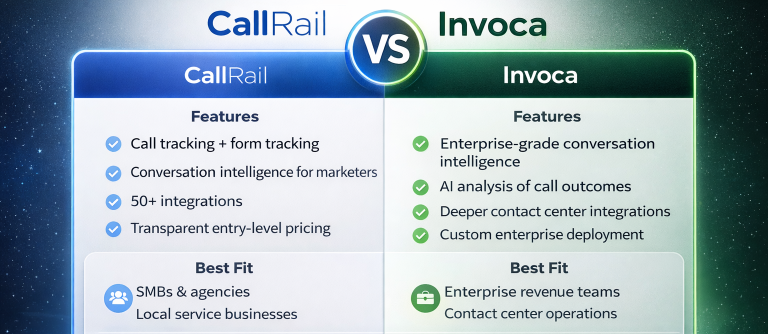
Invoca is built around enterprise call tracking, conversation intelligence, integrations, and revenue execution across marketing, contact center, and multi-location teams. Ringba is built around inbound call operations, partner management, routing logic, and pay-per-call economics. That makes this comparison less about “best platform overall” and more about business model fit.
Quick answer
Choose Invoca if your team cares most about AI-powered call analysis, ad-platform feedback loops, enterprise integrations, and compliance-heavy environments.
Choose Ringba if your business lives in pay-per-call, call marketplaces, affiliate-style partner relationships, real-time routing, or call trading economics.
That is the shortest honest answer. Everything else is detail.
At-a-glance comparison
| Category | Invoca | Ringba |
| Best fit | Enterprise brands, agencies, contact centers, multi-location teams | Pay-per-call, performance marketers, call centers, networks |
| Pricing | Quote-based Pro and Enterprise packages | Public pricing from $147/mo monthly or $127/mo annually for Business |
| Core strength | AI conversation intelligence and revenue attribution | Routing, ring trees, call trading, partner operations |
| Integrations | Strong no-code and enterprise integrations | Open API, webhooks, operational flexibility |
| Compliance | Strong public emphasis on SOC 2 Type 2, ISO 27001, HIPAA, GDPR, PCI DSS | Public emphasis is more operational than compliance-led |
| White label | Not a major public positioning point | Publicly available in higher tiers |
| Real-time bidding / ring trees | Not a core public differentiator | Core differentiator |
This is the biggest strategic split: Invoca is trying to connect conversations to enterprise revenue systems, while Ringba is trying to maximize operational yield from inbound calls.
Where Invoca pulls ahead
Invoca is the stronger platform when the phone call is just one part of a larger revenue and analytics system.
Its public product pages emphasize Signal AI, call quality measurement, conversation analytics, agent scoring, no-code integrations, and the ability to push conversation data into platforms like Google Ads, Meta, Salesforce, Five9, GA4, and other enterprise systems. That matters if your team wants more than call logs. It matters if you want to classify call intent, understand what was said, score outcomes automatically, and feed those outcomes back into bidding and reporting systems.
Invoca also looks stronger for regulated or enterprise-sensitive environments. Its security and compliance page publicly highlights SOC 2 Type 2, ISO 27001, HIPAA, GDPR, PCI DSS, SAML, and controls for redaction and access. Ringba does mention automated compliance on its homepage, but its public positioning is still much more centered on routing, partner workflows, and pay-per-call operations than on enterprise governance and compliance frameworks.
This is why Invoca tends to make more sense for healthcare, insurance, financial services, large home services brands, and multi-location businesses where marketing, sales, and contact center data need to stay connected. Its pricing page is also clearly sales-led: Pro and Enterprise packages are quoted based on business needs, with add-ons for Signal AI, premium integrations, advanced IVR, and AI-powered quality management.
“Invoca shows us the true, verifiable number of sales calls our marketing campaigns drive. This has led to a 100% increase in revenue from ad campaigns.”
— Brian Todd, Senior Business Analyst, BBQGuys
Where Ringba pulls ahead
Ringba is the stronger platform when calls are not just tracked, but bought, sold, routed, scored, and operationally optimized in real time.
Its public site and pricing pages emphasize Ring Trees, Predictive Routing, Revenue Recovery, white label support, partner users, partner sub-accounts, webhooks, open APIs, and real-time call management. Its support docs go deeper into routing logic, ring tree targets, predictive routing, and revenue recovery, which tells you a lot about the product’s real center of gravity. This is a platform for teams that need control over call flow economics, not just marketing attribution.
Ringba is also much easier to understand from a pricing perspective. Unlike Invoca, it publishes concrete prices: Business starts at $147 per month billed monthly or $127 billed annually, while Professional starts at $297 monthly or $197 annually, with Enterprise custom pricing above that. On top of the subscription, Ringba publicly lists usage pricing for local tracking, toll-free tracking, numbers, call recording, caller profile pulls, and AI-related transcription or summarization services.
That transparency matters for performance marketers and pay-per-call operators. Ringba’s homepage also explicitly says “No contracts, feature gatekeeping, or price gouging,” and positions the product as partner-centric and built on a completely open framework. That is a very different buying experience from Invoca’s quote-led enterprise packaging.
Ringba also looks like the better operational fit for agencies or networks managing buyers, sellers, overflow logic, ring trees, and call monetization. Its product language is much closer to the needs of affiliate ecosystems, real-time bidding setups, and private call marketplaces than to classic enterprise marketing attribution.
“We are laser-focused on driving inbound phone calls, which we’ve always taken to be a superior product versus a traditional form fill.”
— Anthony Sarandrea
Pricing and buying model
This may be the deciding factor for a lot of readers.
Invoca is the more enterprise-style purchase. You will not get a simple self-serve entry point. You get quoted Pro or Enterprise packages, optional add-ons, and a platform that is clearly meant to be evaluated with stakeholder involvement. That does not make it worse. It just means it is optimized for larger teams and more complex rollouts.
Ringba is easier to model financially if you are already comfortable with usage-based economics. The tradeoff is that your invoice depends on how much you route, record, enrich, and analyze. For pay-per-call businesses, that can be a good thing. For a traditional brand team that wants simpler budgeting and broader business-facing analytics, it may feel more operational than necessary.
Final verdict
If your business is an enterprise brand, multi-location company, or serious revenue team that needs AI-powered call intelligence, strong compliance posture, and tight integrations with ad platforms and CRMs, Invoca is the stronger fit.
If your business is built around performance marketing, call routing, pay-per-call, partner operations, or real-time yield optimization, Ringba is the better fit.
Invoca is better when you want to understand and activate the conversation.
Ringba is better when you want to control and monetize the call flow.